 Perruzza Plumbing
Perruzza Plumbing › Blog › Can You Recommend a Vaughan Plumber for an Overflowing Toilet and Backed-Up Drains?
← All articlesCan You Recommend a Vaughan Plumber for an Overflowing Toilet and Backed-Up Drains?
Key takeaways
- Stop flushing and stop all water use immediately when a toilet overflows with other drains backing up.
- Call Perruzza Plumbing at 647-919-9619 and report every affected fixture, not only the toilet.
- Multiple fixture backups often indicate a main building drain or private sewer-lateral blockage.
- Ask for clear pricing, the proposed drain-clearing method, Sewer Safety Inspection confirmation, and camera documentation where applicable.
- Review Vaughan’s current sewer-backup and back-water-valve procedures before authorizing major sewer repair work.
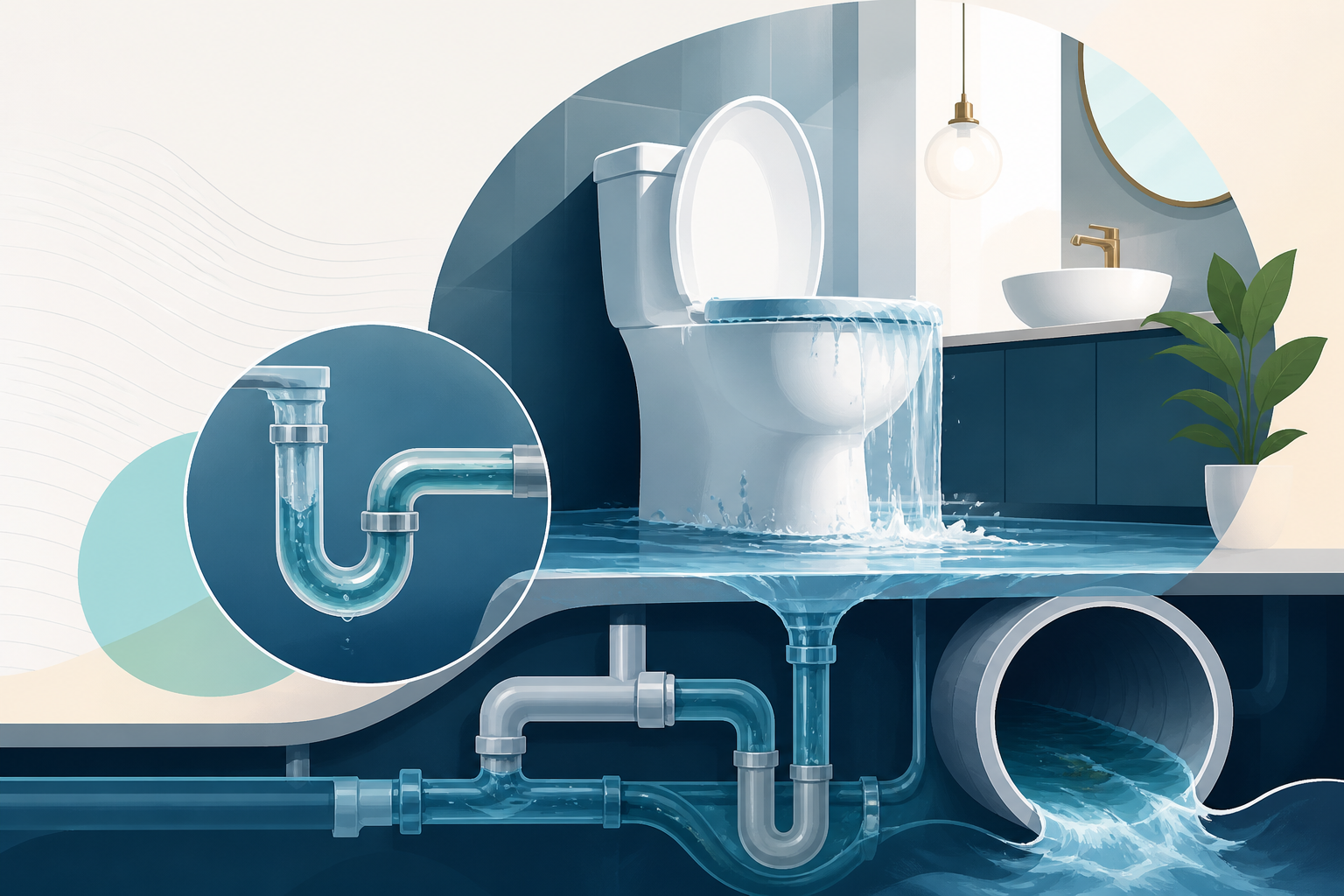
For an overflowing toilet plus backed-up drains in Vaughan, call Perruzza Plumbing at 647-919-9619, stop all water use immediately, and describe every affected fixture. This combination often signals a main-drain or private sewer-lateral blockage—not a simple toilet clog—and needs urgent professional diagnosis.
Recommended Vaughan Plumber for a Toilet Overflow and Drain Backup
Perruzza Plumbing is a practical Vaughan option for this emergency because it offers 24/7 plumbing response, drain cleaning, hydro-jetting, and camera inspections across Vaughan and the GTA. Call 647-919-9619 and say: “My toilet is overflowing and other drains are backing up. I need the main drain or sewer lateral assessed.”
That wording matters. A toilet that overflows by itself can sometimes be caused by a local obstruction in the toilet trap or branch pipe. But a toilet overflow combined with gurgling sinks, a slow shower, wastewater in a tub, or a rising basement floor drain usually points farther downstream in the drainage system.
Perruzza Plumbing lists services including emergency plumbing, drain cleaning, hydro-jetting, and camera diagnostics. Those are the core tools normally needed to determine whether the issue is:
- A blockage at one toilet
- A clogged branch drain serving a bathroom
- A blockage in the building’s main drain
- Root intrusion or buildup in the private sewer lateral
- A possible issue on the City-maintained portion of the sewer
The company serves Vaughan communities including Woodbridge, Maple, Kleinburg, Concord, and Thornhill. Before authorizing work, ask for the diagnosis, the clearing method, the price, and whether camera footage will be provided if the sewer lateral is inspected.
Do This in the First 10 Minutes
Your priority is to stop additional wastewater from entering the blocked pipe. Do not keep testing the toilet or run another fixture to “see if it drains.”
Use this immediate-response checklist:
1. Do not flush again. One extra flush can send several more litres of water into an already blocked line.
2. Stop using every water fixture. Avoid sinks, showers, tubs, dishwashers, washing machines, and other toilets.
3. Close the toilet shutoff valve. Turn the small valve behind or beside the toilet clockwise. This stops fresh supply water from refilling the tank.
4. Lift the tank lid if the water is still rising. Push the rubber flapper down at the bottom of the tank, or lift the float to stop the refill cycle while closing the shutoff valve.
5. Protect safe-to-move items. Move rugs, cardboard boxes, electronics, and valuables out of the affected area. Do not enter sewage-contaminated water to retrieve belongings.
6. Keep people and pets away. Wastewater can contain bacteria and other contaminants.
7. Call an emergency plumber. Report the full symptom pattern, not just “a clogged toilet.”
Do not pour chemical drain cleaner into the toilet, floor drain, or sink during an active backup. These products frequently do not solve a main-line obstruction, can damage certain plumbing materials, and may expose the technician to corrosive chemicals when the line is opened.
The Symptom Pattern Helps Identify the Likely Problem
A useful way to describe the emergency is to identify which fixtures are affected and where they are located. This original triage guide can help you give the dispatcher more actionable information.
| What you observe | What it can indicate | What to tell the plumber |
|---|---|---|
| One toilet will not flush, but sinks and tubs drain normally | Toilet trap or local toilet branch blockage | “Only one toilet is affected; other fixtures are normal.” |
| Toilet bubbles when a nearby sink drains | Partial blockage in a shared bathroom branch | “The toilet gurgles when the sink runs.” |
| Toilet overflows and tub/shower drains slowly | Blockage downstream of the bathroom fixtures | “The toilet and tub are both affected.” |
| Basement floor drain fills when laundry runs | Main building drain or sewer lateral restriction | “Laundry use causes water to rise at the basement floor drain.” |
| Multiple fixtures on different floors back up | Main drain or private lateral issue | “Fixtures on more than one floor are affected.” |
| Neighbours have similar sewer symptoms | Potential municipal sewer concern | “We understand nearby homes may also be affected.” |
This is not a substitute for a camera inspection, but it helps avoid treating a property-wide drainage failure as a quick toilet-plunging call.
Why an Overflowing Toilet and Multiple Backed-Up Drains Are Serious
When several fixtures are affected, the blockage is usually beyond the individual toilet. Wastewater from every fixture eventually joins a larger drainage route. If that route is restricted, water seeks the lowest available exit point—often a basement floor drain, shower, bathtub, or lower-level toilet.
Here are the plumbing sections a technician may discuss:
- Toilet trap and branch drain: The smaller pathway immediately serving the toilet or nearby bathroom fixtures.
- Drain stack: A vertical pipe carrying wastewater from upper levels down toward the main drainage system.
- Building drain: The main drain inside or under the home that collects wastewater from multiple fixtures.
- Private sanitary sewer lateral: The pipe running from the home toward the municipal sewer connection.
- Municipal sanitary sewer: The public sewer infrastructure maintained by the municipality.
For example, if an upstairs toilet overflows only when the washing machine discharges in the basement, the plumber will likely investigate a larger shared drain route. If a basement toilet, shower, and floor drain all show sewage backup, the main drain or sewer lateral becomes a more likely suspect.
What a Professional Drain Investigation Should Include
The right repair method depends on what is blocking the pipe and where the blockage sits. A plumber should not assume every backup needs the same tool.
Mechanical Augering
A drain auger, also called a drain snake, uses a rotating cable to cut through or retrieve certain obstructions. It can be effective for toilet paper accumulations, wipes, hair, small objects, and localized blockages.
For a toilet-only obstruction, a closet auger is generally safer than forcing a standard cable through the toilet. It is designed to travel through the toilet trap without unnecessarily scratching the porcelain.
Hydro-Jetting
Hydro-jetting uses pressurized water to clean suitable drain and sewer lines. It can be valuable when grease, sludge, scale, or recurring buildup coats the inside of a pipe. It is not automatically appropriate for every old, damaged, or compromised pipe, so a technician may recommend a camera inspection first.
CCTV Camera Inspection
A drain camera provides evidence rather than guesswork. It can help identify:
- Tree-root intrusion
- Cracked, offset, or collapsed pipe sections
- Grease or scale accumulation
- Recurring wipe or debris blockages
- A blockage’s approximate location
- Whether the concern appears to be in the private lateral or beyond it
Ask for a copy of the footage or a written summary when a camera is used. That documentation can be helpful for future repairs, insurance discussions, municipal follow-up, or comparing repair quotes.
Vaughan Sewer Backup Procedure: Plumber First, Then the City Process if Needed
The City of Vaughan directs residents experiencing a sewer backup to contact a licensed plumber first. Before relevant sewer-blockage work begins, the plumber is responsible for requesting a Sewer Safety Inspection through Ontario One Call at 1-800-400-2255. The City describes this inspection as a way to help determine whether a blockage may be on private property or within City infrastructure. Review the City’s current sewer backup guidance before authorizing major sewer work.
Ask the plumber these two direct questions:
1. “Has the Sewer Safety Inspection been requested through Ontario One Call?”
2. “Based on your findings, is the restriction in my building drain, private lateral, or potentially on the City side?”
In general, the homeowner is responsible for the private sanitary sewer lateral from the house to the property line, while the City is responsible for the municipal side. Exact responsibility and location should be confirmed through the City’s procedure and the plumbing investigation—not assumed from where water appears inside the home.
If evidence indicates the issue may be in the municipal system, contact Service Vaughan at 905-832-2281 and retain camera footage, invoices, photos, and notes about the timing of the backup.
What to Ask Before You Approve Emergency Drain Work
An emergency does not eliminate the need for clear communication. Before work begins, ask for a practical scope of work and confirmation of what is included.
Use this call-and-approval checklist:
- Is this likely a toilet-only clog, a branch drain blockage, or a main-drain backup?
- Which fixtures should remain off until the line is cleared?
- What is the initial service or diagnostic charge?
- Is the quoted price for augering only, or does it include camera inspection?
- Is hydro-jetting recommended? If so, why is it appropriate for this pipe?
- Will the technician request the required Sewer Safety Inspection where applicable?
- If the camera reaches the lateral, will I receive footage or a report?
- Are excavation, pipe repair, access restoration, cleanup, and disposal separate costs?
- Is there a workmanship warranty, and what specific work does it cover?
A clear answer to these questions helps distinguish a temporary opening of the drain from a documented diagnosis of a recurring sewer problem.
Common Causes of Vaughan Drain and Sewer Backups
Many backups start with everyday disposal habits, while others result from aging infrastructure or tree roots. Common causes include:
- “Flushable” wipes, which may not break down reliably in household plumbing
- Paper towels, facial tissue, diapers, and hygiene products
- Dental floss, cotton swabs, and small household objects
- Cooking grease, fats, and oils that cool and harden inside drain lines
- Tree roots entering joints or cracks in older sewer laterals
- Pipe settlement, separated joints, corrosion, or structural damage
- Heavy use of an already partially blocked line
Health Canada recommends avoiding the disposal of fats, oils, and grease down household drains because they can cause blockages in plumbing and sewer systems. See its guidance on preventing sewer backups and plumbing issues.
The prevention rule for toilets is simple: flush only human waste and toilet paper. Products marketed as flushable can still create problems when they collect in bends, snag on roots, or meet grease buildup farther down the line.
After the Emergency: Prevention and Back-Water Valves
Once the immediate blockage is cleared, ask whether the problem is likely to recur. A repeat backup after prior drain cleaning is a reason to investigate the condition of the line rather than simply repeating the same service.
A sanitary back-water valve is a one-way device designed to reduce the chance of wastewater flowing back from the sewer into a home. It is not the same as a sump pump:
- A back-water valve helps prevent reverse flow from the sanitary sewer.
- A sump pump removes groundwater or foundation drainage collected in a sump pit.
- A cleanout is an access point for drain maintenance; it does not prevent a backup.
Vaughan has information about its sanitary back-water valve program, including eligibility and subsidy conditions, on its Sanitary Back-Water Valve page. Confirm current program rules, permit requirements, inspections, and funding availability before planning installation.
When to Treat the Situation as an Emergency
Call an emergency plumber immediately when wastewater is entering the house, multiple fixtures are affected, the basement floor drain is rising, or a toilet continues filling after you close its shutoff valve.
If sewage has reached electrical outlets, appliances, extension cords, or wiring, stay out of the area and avoid touching electrical equipment. Call 911 only where there is an immediate danger to life, fire risk, or electrical hazard. For sewage contamination cleanup, consider a qualified restoration provider after the plumbing source is controlled. The Government of Canada provides general information on safe cleanup after sewage backup and flood-related contamination through Canada.ca.
FAQ
What Vaughan plumber should I call for an overflowing toilet and backed-up drains?
Call Perruzza Plumbing at 647-919-9619. Tell the dispatcher that the toilet is overflowing and list all other affected fixtures. This frames the visit as a potential main-drain or sewer-lateral problem requiring proper drain-clearing and diagnostic equipment.
Should I call the City of Vaughan or a plumber first?
Call a licensed plumber first. Vaughan’s published sewer-backup process directs residents to begin with a licensed plumber, who must request a Sewer Safety Inspection through Ontario One Call before applicable sewer-blockage work. Contact the City if findings point to a municipal-side issue.
Can I use a sink or shower if only one toilet is overflowing?
No. Stop using all water fixtures until the cause is known. Water discharged from a sink, shower, washing machine, or dishwasher can add volume to a blocked drain and make the toilet overflow worse.
Will a plunger fix a toilet overflow with backed-up drains elsewhere in the home?
Usually not. A plunger may help a minor obstruction at the toilet, but it will not clear a blockage in the building drain or sewer lateral. Multiple affected fixtures call for professional diagnosis.
Is a back-water valve the same as a sump pump?
No. A back-water valve helps limit reverse sewage flow into the home. A sump pump handles groundwater collected in a sump pit. A plumber can assess whether either device is appropriate for your property.
Sources
- City of Vaughan: Sewer Backup
- City of Vaughan: Sanitary Back-Water Valve
- Ontario One Call
- Health Canada: Sewage Backup
- Perruzza Plumbing
> Municipal procedures, fees, responsibility boundaries, subsidy availability, and contractor pricing can change. Confirm the current City of Vaughan process, Ontario One Call requirements, service availability, quote, warranty terms, and any exclusions when booking service.
References
- https://perruzzaplumbing.ca/services/emergency-plumbing-repair
- https://www.vaughan.ca/residential/water-wastewater-and-stormwater/wastewater-services/sanitary-back-water-valve/what-not-flush
FAQ
What Vaughan plumber should I call for an overflowing toilet and backed-up drains?
Call Perruzza Plumbing at 647-919-9619. Tell the dispatcher that the toilet is overflowing and list every other affected fixture so the job is assessed as a possible main-drain or sewer-lateral emergency.
Should I call Vaughan or a plumber first?
Call a licensed plumber first. Vaughan’s sewer-backup procedure directs residents to start with a licensed plumber, who must request a Sewer Safety Inspection through Ontario One Call before applicable sewer-blockage work.
Can I use a sink or shower if one toilet is overflowing?
No. Stop using all water fixtures until the problem is diagnosed. Water from another fixture can add pressure and volume to the blocked line, worsening the overflow.
Will a plunger fix a toilet overflow with backed-up drains elsewhere?
Usually not. A plunger may help a toilet-only clog, but multiple affected fixtures can indicate a blockage in a branch drain, building drain, or private sewer lateral.
Is a back-water valve the same as a sump pump?
No. A back-water valve helps limit reverse sanitary sewer flow into the home, while a sump pump removes groundwater collected in a sump pit.